A Qualifying Free Zone Person (QFZP) is a Free Zone company that meets six legal conditions and so pays 0% corporate tax on its qualifying income and 9% on the rest. The key tests are real substance in the Free Zone, audited accounts, and non-qualifying revenue no higher than 5% of total revenue or AED 5 million, whichever is lower. Fail one, and the company loses QFZP status for that tax period and the next 4, so standard corporate tax applies for 5 periods.
Last updated: 10 November 2026 · Facts checked on tax.gov.ae and mof.gov.ae on 10 Nov 2026 · By 800 Business
What are the six conditions to be a QFZP?
A Free Zone company is treated as a QFZP unless it fails a condition or chooses to leave the regime (FTA Corporate Tax Guide on Free Zone Persons, CTGFZP1). The conditions come from Article 18 of the Corporate Tax Law and Article 5 of Ministerial Decision No. 229 of 2025:
| # | Condition | What it means in practice |
|---|---|---|
| 1 | Adequate substance in the Free Zone | The core money-making work happens in the Free Zone, with enough staff, assets and spending there |
| 2 | Qualifying income | The company earns qualifying income (see the next section) |
| 3 | No election out | The company hasn't chosen to be taxed under the standard rules |
| 4 | Arm's length pricing | Deals with related companies are priced as if between strangers |
| 5 | Transfer pricing documentation | The company keeps the transfer pricing records the law asks for |
| 6 | Audited financial statements and the de minimis test | Accounts are audited every year, whatever the revenue, and non-qualifying revenue stays within the limit |
The FTA treats the audit and de minimis rules as two separate conditions, which is why some guides count seven. Either way, every one must be met for the whole tax period.
Which income is taxed at 0%?
According to the FTA guide, qualifying income comes from four sources:
- Sales to other Free Zone companies that are the real users of the goods or services (the "beneficial recipient"). The activity doesn't need to be on the qualifying list, as long as it isn't an excluded activity.
- Qualifying activities, even with customers outside the Free Zone, as long as they aren't excluded activities.
- Income from qualifying intellectual property that the company developed, worked out by a formula.
- Any other income, as long as the company stays within the de minimis limit.
The qualifying activities are set by Ministerial Decision No. 229 of 2025, which replaced Decision No. 265 of 2023 with effect from 1 June 2023:
| Qualifying activities (0% even with non-Free Zone customers) | Excluded activities (never qualifying) |
|---|---|
| Manufacturing goods or materials | Most transactions with individuals (natural persons) |
| Processing goods or materials | Banking |
| Trading qualifying commodities (metals, minerals, industrial chemicals, energy, agricultural and environmental commodities with a quoted price) | Insurance, except reinsurance and some related-party insurance |
| Holding shares and securities for investment | Finance and leasing, with some exceptions |
| Owning, managing and operating ships | Owning or exploiting property, except commercial property in a Free Zone dealt with another Free Zone company |
| Reinsurance, fund management, wealth and investment management | Activities that support any of the above |
| Headquarter services to related parties | |
| Treasury and financing services to related parties or for its own account | |
| Financing and leasing aircraft | |
| Distribution of goods in or from a Designated Zone | |
| Logistics services | |
| Activities ancillary to any of the above |
Where most small Free Zone companies get caught: consulting, marketing, IT services, coaching and design aren't on the qualifying list. Sold to other Free Zone companies, that income can still be qualifying. Sold to mainland companies, to companies abroad or to individuals, it's non-qualifying. So a one-person IFZA or Meydan consultancy with clients in Europe usually has mostly non-qualifying revenue.
How does the de minimis test work? A worked example
The de minimis test lets a QFZP earn a small amount of non-qualifying revenue without losing its status. The limit is the lower of 5% of total revenue or AED 5,000,000 in the tax period (Ministerial Decision No. 229 of 2025, Article 3).
| Company A | Company B | |
|---|---|---|
| Total revenue for the year | AED 2,000,000 | AED 2,000,000 |
| Revenue from Free Zone customers (qualifying) | AED 1,920,000 | AED 1,850,000 |
| Revenue from mainland customers (not a qualifying activity) | AED 80,000 | AED 150,000 |
| Limit: lower of 5% (AED 100,000) or AED 5m | AED 100,000 | AED 100,000 |
| Non-qualifying share | 4%: passes | 7.5%: fails |
| Result | Stays a QFZP. Qualifying income at 0% | Not a QFZP this tax period and the next 4. Standard corporate tax applies |
Company B lost the 0% rate because its mainland sales went AED 50,000 over the limit. When the test is failed, the company drops out of the QFZP regime from the start of that tax period and for the following four (Ministerial Decision No. 229 of 2025, Article 5(2)). The FTA guide notes some revenue is left out of the calculation, such as revenue of a branch outside the Free Zone and some property income.
Do Free Zone companies need audited accounts?
Yes, if they want to be a QFZP. Ministerial Decision No. 229 of 2025 makes audited financial statements a condition for every QFZP, under Ministerial Decision No. 84 of 2025, whatever the company's size. A Free Zone company that skips the audit stops being a QFZP from the start of that tax period and for the next four (Ministerial Decision No. 229 of 2025, Article 5).
See our audited accounts service if you need one.
What changed for Free Zone distributors in 2026?
FTA Decision No. 6 of 2026 adds a step for QFZPs whose qualifying activity is distribution of goods in or from a Designated Zone (the FTA's English translation on tax.gov.ae, checked 10 Nov 2026). It applies to tax periods starting on or after 1 January 2026.
- The company must get an agreed-upon procedures report (under the international standard ISRS 4400) from its external auditor or another UAE-licensed auditor.
- The report checks a sample of the largest customers, sales and imports to show that customers resell or process the goods, and that goods the company imports into the UAE came in through a Designated Zone.
- The company must keep evidence: customer trade licences, signed customer declarations, sales records, import declarations and shipping documents.
- The report is due 30 days after the corporate tax return deadline. For a financial year ending 31 December 2026, the return is due 30 September 2027, so the report is due by 30 October 2027.
- If the report isn't sent, the FTA treats the distribution conditions as not met.
Not every Free Zone is a Designated Zone. The FTA's public clarification TAXP010 (October 2026) explains how to check. Most service companies in IFZA, Meydan or RAKEZ don't distribute goods, so this rule doesn't apply to them.
Not sure if your Free Zone company is a QFZP? In a free 30-minute call we look at where your revenue comes from and tell you which route fits. Book my free 30-minute call
What if my company doesn't qualify?
A Free Zone company that isn't a QFZP is taxed like any other UAE company. That's often fine:
- The first AED 375,000 of taxable income is taxed at 0%, and the rest at 9%. A QFZP doesn't get this band on its non-qualifying income.
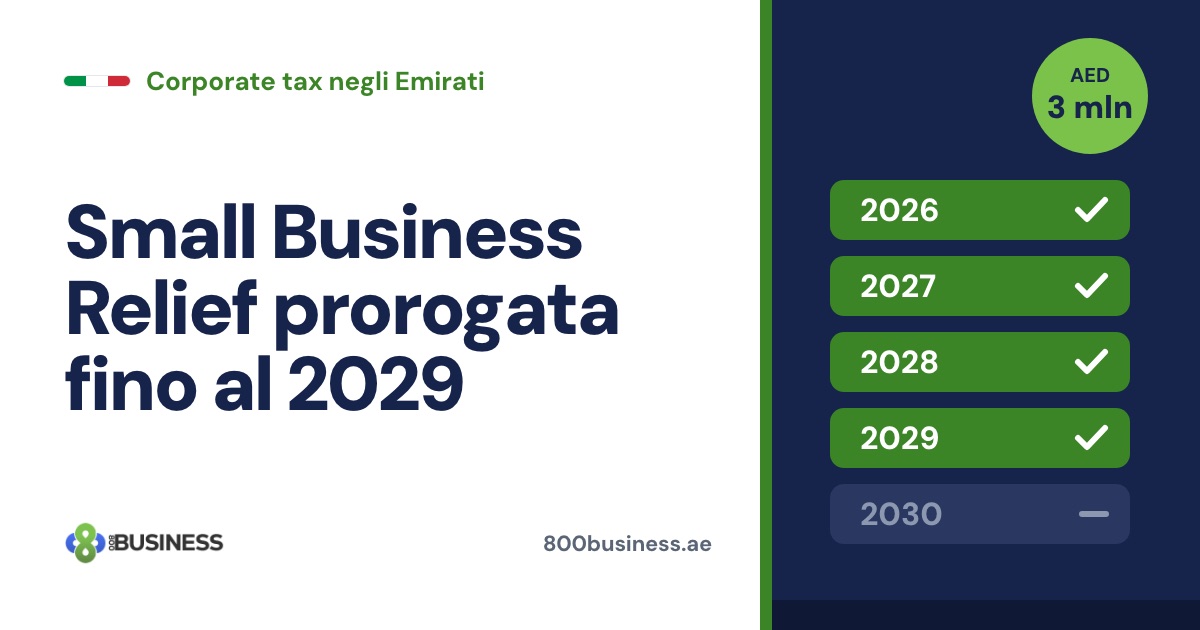
- Small Business Relief lets a company with revenue of AED 3 million or less elect to be treated as having no taxable income, for tax periods ending on or before 31 December 2029 (Ministerial Decision No. 131 of 2026). The FTA guide confirms that a QFZP can't use it, but a Free Zone company outside the QFZP regime can, if it meets the conditions. See our guide to Small Business Relief in the UAE.
- You can choose to leave the QFZP regime (Article 19 of the Corporate Tax Law). The choice is made by the return deadline for that period, and it lasts for that period and the next four.
For many small service companies with foreign or mainland clients, Small Business Relief is the simpler route. It also removes the corporate tax audit condition that comes with QFZP status, though your Free Zone may still ask for financial statements at renewal.
Get advice on your own figures before you choose, because both the election and a failed test lock you in for five periods.Mistakes we see
- Assuming "Free Zone = 0% tax" and never checking where the revenue comes from.
- Selling to individuals through a Free Zone company and counting it as qualifying. Most sales to individuals are excluded.
- Claiming QFZP status with no audit.
- Missing that mainland sales over the limit cost five tax periods of 0%.
Whichever route applies, every Free Zone company must still register for corporate tax and file a return on EmaraTax. Check that your supplier invoices are in order too: our TRN verification guide shows how in 2 minutes.
Frequently asked questions
Is every Free Zone company a Qualifying Free Zone Person? No. A Free Zone company is treated as a QFZP only while it meets all the conditions, including substance, audited accounts and the de minimis test.
What is qualifying income for a Free Zone company? Income from other Free Zone companies (outside excluded activities), from qualifying activities such as manufacturing, logistics or distribution from a Designated Zone, from qualifying intellectual property, and small other income within the de minimis limit.
Can a QFZP sell to mainland companies? Yes, but that income is non-qualifying unless it comes from a qualifying activity. Too much of it breaks the de minimis limit.
What happens if I fail the de minimis test? The company stops being a QFZP from the start of that tax period and for the next four. Standard rates apply: 0% up to AED 375,000 of taxable income, then 9%.
Can a QFZP claim Small Business Relief? No. A Free Zone company outside the QFZP regime can, if its revenue is AED 3 million or less and it meets the other conditions.
Do I still file a corporate tax return if all my income is at 0%? Yes. Every Free Zone company registers for corporate tax and files a return each year on EmaraTax.
Get a clear answer for your company
In a free 30-minute Zoom call, we go through your customers, revenue and licence, and tell you whether QFZP status or Small Business Relief fits better. If you'd like, we keep your books, arrange the audit and prepare your corporate tax return for your approval.
Book my free 30-minute call · Message us on WhatsApp: +971 52 713 7661
Also useful: Corporate tax in the UAE · Free Zone company setup · Accounting services in Dubai · Check my compliance in 2 minutes
Sources
All sources checked on 10 November 2026.
- Federal Tax Authority, Corporate Tax Guide on Free Zone Persons (CTGFZP1) (May 2024): conditions, sources of qualifying income, de minimis calculation, the 375,000 band and reliefs, election out, substance. Its references to Ministerial Decision No. 265 of 2023 now read as No. 229 of 2025
- Ministry of Finance, Ministerial Decision No. 229 of 2025 on Qualifying Activities and Excluded Activities (issued 28 August 2025, effective 1 June 2023): Articles 2, 3, 5 and 6 (Article 5(2): a failed condition means losing QFZP status from the start of that tax period and for the next 4)
- Federal Tax Authority, FTA Decision No. 6 of 2026 on additional procedures for QFZPs (issued 2 June 2026; FTA's English translation): Articles 2, 3 and 5
- Federal Tax Authority, Corporate tax legislation list and Public clarification TAXP010: Free Zones and Designated Zones for tax purposes (October 2026)
- Ministry of Finance, Ministerial Decision No. 131 of 2026 on Small Business Relief
- Federal Tax Authority, FY2025 corporate tax return deadline release: the 9-month filing rule
Update trigger: a new FTA Free Zone Persons guide; any change to the qualifying activities list; an FTA guide on the distributor report; changes to Small Business Relief.
Next step: Accounting services in Dubai