
Last updated: 10 November 2026 · Facts checked on mof.gov.ae, tax.gov.ae and ifrs.org on 10 November 2026
The short answer
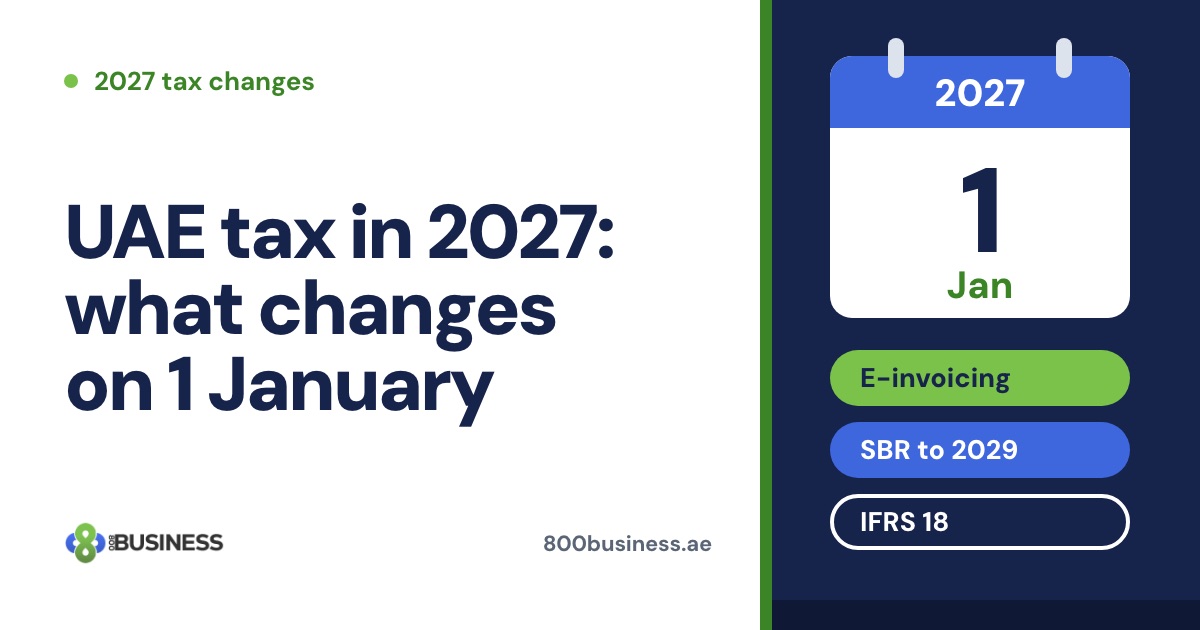
On 1 January 2027, e-invoicing becomes mandatory in the UAE for businesses with revenue of AED 50 million or more. Everyone else must appoint an e-invoicing provider by 31 March 2027 and go live on 1 July 2027. Small Business Relief does not end: it now runs to tax periods ending on 31 December 2029. Old VAT credits must be claimed by 31 December 2026.
2027 at a glance
| Date | What changes | Who it affects | Status (10 Nov 2026) |
|---|---|---|---|
| 31 Dec 2026 | Last day to request a refund of old tax credit balances | Businesses with old VAT credits on EmaraTax | Law, window closing |
| 1 Jan 2027 | E-invoicing mandatory, revenue AED 50m or more | Large businesses, and the smaller firms they buy from and sell to | Law |
| 1 Jan 2027 | Invoices between members of one VAT tax group excluded from e-invoicing for 24 months | VAT tax groups | Law |
| 1 Jan 2027 | IFRS 18 replaces IAS 1 for years starting on or after this date | Companies that prepare IFRS accounts | Accounting standard |
| 31 Mar 2027 | Appoint an e-invoicing service provider (revenue below AED 50m) | Most SMEs and Free Zone companies | Law |
| 31 Mar 2027 | Corporate tax registration for individuals with 2026 business turnover above AED 1 million | Freelancers and sole traders | Law |
| 1 Jul 2027 | E-invoicing mandatory, revenue below AED 50m | Most SMEs and Free Zone companies | Law |
| 30 Sep 2027 | Corporate tax return and payment for a year ending 31 Dec 2026 | Every company with a December year end | Law |
| 1 Oct 2027 | E-invoicing for government entities | Government, and the businesses that bill them | Law |
| Not set yet | No input VAT on cash payments above a threshold | VAT-registered businesses that pay in cash | Law, threshold still to come |
| To 31 Dec 2029 | Small Business Relief (revenue up to AED 3 million) | Small resident businesses | Law |
E-invoicing: the big change of 2027
An e-invoice in the UAE is a structured file sent through an accredited service provider over the Peppol network, with the data reported to the Federal Tax Authority (FTA). A PDF sent by email no longer counts once your phase starts. The FTA confirmed the dates on 25 October 2026: a provider appointed by the end of October 2026 and 1 January 2027 to go live for revenue of AED 50 million or more; 31 March 2027 and 1 July 2027 for everyone else (FTA, checked 10 Nov 2026).
It applies to sales to businesses and to government, including exports, whether or not you are VAT registered. Sales to consumers (people not in business) are out of scope (MoF E-invoicing Guidelines v2.0, checked 10 Nov 2026).
Three things changed in October 2026:
- New fines. Cabinet Decision No. 173 of 2026 replaced Cabinet Decision No. 106 of 2025. Not going live or not appointing a provider, whether you issue e-invoices or only receive them, costs AED 5,000, plus AED 5,000 for each month it continues, capped at AED 50,000 in any 12 months (CD 173/2026, checked 10 Nov 2026). The decision takes effect the day after it appears in the Official Gazette, and the fines only apply from your own mandatory date.
- Less red tape. Ministerial Decision No. 197 of 2026 removed the rule to store e-invoice data inside the UAE and the duty to report a system failure within 2 business days, from 1 October 2026 (MoF, checked 10 Nov 2026).
- A break for groups. Invoices between members of the same VAT tax group are excluded for 24 months from 1 January 2027 (same source). By our count, that runs to 31 December 2028.
Why a small business should care on 1 January: your big suppliers go live first. Until your own date, the guidelines say they must send you a normal tax invoice (a PDF, for example) as well as the e-invoice, so you can still reclaim your VAT. If a big supplier only sends XML, ask for the PDF. Full guide: UAE e-invoicing: deadlines, rules and fines.
Small Business Relief still applies in 2027
Many articles still say Small Business Relief ends in 2026. That is out of date. Ministerial Decision No. 131 of 2026 extends it to tax periods ending on or before 31 December 2029. The revenue limit stays at AED 3 million, in the current period and every earlier one (MoF, checked 10 Nov 2026).
You still have to choose it on each corporate tax return. Qualifying Free Zone Persons and members of large multinational groups can't use it. Details: Small Business Relief extended to 2029.
Corporate tax: the 2027 dates that matter
Nothing new in the law, but 2027 is a busy filing year:
- 30 September 2027: return and payment for a financial year ending 31 December 2026. The rule is 9 months after the year end (CT Law, Articles 48 and 53, checked 10 Nov 2026).
- 31 March 2027: individuals whose 2026 business turnover went above AED 1 million must register. Late registration costs AED 10,000 (FTA, checked 10 Nov 2026).
- New companies register within 3 months of incorporation, Free Zone companies included (FTA Decision No. 3 of 2024, checked 10 Nov 2026).
Every date for every year end: UAE tax deadlines 2027. Our article on corporate tax for freelancers follows on 27 November.
VAT: a closing window and two new rules
Old credits: claim by 31 December 2026. Since 1 January 2026, a refund of a tax credit must be requested within 5 years of the end of the tax period. Older balances get one last year, which ends on 31 December 2026 (MoF, checked 10 Nov 2026). How to check yours: old VAT credit refund.
Cabinet Decision No. 149 of 2026 changed the VAT Executive Regulation (MoF, 8 Sep 2026, checked 10 Nov 2026):
- Cash payments: input VAT can't be recovered when you pay in cash above a threshold. The Minister of Finance still has to set that threshold, so the rule can't bite yet. Paying suppliers by bank transfer now avoids the problem later.
- Staff housing: the rules on reclaiming input VAT on employee accommodation were clarified.
- Apportionment: a revised method for businesses with both taxable and exempt sales. The Ministry's announcement gives no start date; tax firms' summaries say it applies from a tax year starting after 1 October 2027, so check with your accountant before you change anything.
Penalties: we found no new VAT or corporate tax penalty decision for 2027. The VAT fines changed on 14 April 2026 (Cabinet Decision No. 129 of 2025) and still apply.
IFRS 18: a new look for your financial statements
IFRS 18 applies to annual reporting periods beginning on or after 1 January 2027 and replaces IAS 1, the standard on how financial statements are presented (IFRS Foundation, checked 10 Nov 2026). If your accounts follow full IFRS, your 2027 income statement will look different, and the 2026 comparatives must be shown the same way. What it means for audits: IFRS 18 explained.
What does not change in 2027
- Corporate tax rates: 0% on taxable income up to AED 375,000 and 9% above it (CT Law, Article 3, with the threshold in Cabinet Decision No. 116 of 2022, checked 10 Nov 2026).
- VAT rate: 5% (Federal Decree-Law No. 8 of 2017 on VAT, FTA legislation page, checked 10 Nov 2026).
- Economic substance: no notifications or reports. They were cancelled for financial years ending after 31 December 2022 (MoF, checked 10 Nov 2026).
- Golden visa and visa fees: we found no 2027-dated change on u.ae or icp.gov.ae (checked 10 Nov 2026).
- Public holidays: the official 2027 list isn't out yet. Expected dates: UAE public holidays 2027.
Moving from Italy? Two changes on the Italian side
- Law: Italy's new income-tax code (D.Lgs. 117/2026) applies from 1 January 2027. The 183-day residence rule stays in article 2; most other article numbers change.
- Proposal only: Italy's 2027 budget bill (A.C. 3174-bis, article 17) would add a 26% exit tax on unrealised gains for people who leave after at least 6 of the last 10 years as residents, with shares, funds or crypto worth €800,000 or more. Parliament can still change it (Camera dei Deputati, checked 10 Nov 2026). Read Italy's exit tax and moving to Dubai and talk to your adviser in Italy before you fix a moving date.
Your 2027 checklist
- Today: look for old VAT credits on EmaraTax. Request them by 31 December 2026.
- January: check your revenue for your latest financial year. Below AED 50 million? Your e-invoicing date is 1 July 2027.
- By 31 March 2027: sign with an accredited e-invoicing provider. Freelancers: register for corporate tax if 2026 turnover went above AED 1 million.
- April to June: test e-invoices and credit notes, and clean your customer data.
- By 30 September 2027: file your corporate tax return for 2026 and choose Small Business Relief if you qualify.
Frequently asked questions
Does Small Business Relief end on 31 December 2026? No. Ministerial Decision No. 131 of 2026 extended it to tax periods ending on or before 31 December 2029. The AED 3 million revenue limit is unchanged.
Does e-invoicing apply to my small Free Zone company in 2027? Yes, if you sell to other businesses or to government. With revenue below AED 50 million, appoint a provider by 31 March 2027 and go live by 1 July 2027.
What is the fine for missing the e-invoicing deadline? AED 5,000, plus AED 5,000 for each month or part of a month it continues, with a cap of AED 50,000 in any 12 consecutive months (Cabinet Decision No. 173 of 2026).
Is there a new VAT rate in 2027? No. VAT stays at 5%. The changes are in the detail: cash payments, staff housing and apportionment.
When is my corporate tax return due in 2027? 9 months after your financial year end. For a year ending 31 December 2026, that is 30 September 2027.
This guide is general information based on official sources, reviewed by the 800 Business team. It is not tax advice.
Want to know which 2027 changes hit your company?
In a free 30-minute Zoom call we look at your revenue, your year end and your EmaraTax account, and tell you which of these dates apply to you and what to do first. If you'd like, we prepare the filings and send them to you for approval before anything goes to the FTA.
Book my free 30-minute call · Message us on WhatsApp: +971 52 713 7661
Also useful: corporate tax in the UAE · VAT registration in the UAE · accounting services in Dubai
Sources
All sources checked on 10 November 2026.
- Federal Tax Authority, FTA calls on persons subject to e-invoicing to comply with the prescribed deadlines (25 October 2026): 1 Jan 2027 and 31 Mar 2027 / 1 Jul 2027 (it gives 30 Oct 2026 for the large-business provider date; the MoF guidelines give 31 Oct)
- Ministry of Finance, UAE Electronic Invoicing Guidelines v2.0 (26 October 2026): scope, consumers out of scope, exports in scope, government entities from 1 Oct 2027, normal tax invoices for buyers not yet live
- Ministry of Finance, Cabinet Decision No. 173 of 2026 and MoF announcement (30 October 2026): e-invoicing fines, AED 50,000 cap, CD 106/2025 repealed
- Ministry of Finance, Ministerial Decision No. 197 of 2026 (19 October 2026): tax-group exclusion, storage, system failures
- Ministry of Finance, Small Business Relief extended to 31 December 2029 (7 August 2026) and Ministerial Decision No. 131 of 2026
- Ministry of Finance, Amendments to the Tax Procedures Law from early 2026 (29 November 2025): 5-year refund rule and transitional window
- Ministry of Finance, Amendments to the VAT Executive Regulation (8 September 2026): Cabinet Decision No. 149 of 2026
- Ministry of Finance, Federal Decree-Law No. 47 of 2022 on Corporate Tax: Articles 48 and 53
- Federal Tax Authority, FTA Decision No. 3 of 2024 and natural persons release: registration deadlines, AED 10,000 penalty
- Ministry of Finance, Economic substance amendment
- IFRS Foundation, IFRS 18 Presentation and Disclosure in Financial Statements
- Camera dei Deputati, A.C. 3174-bis, Legge di Bilancio 2027: exit tax proposal (article 17)
Update trigger: any change in a linked article; a new MoF or FTA decision on e-invoicing, VAT or corporate tax; the threshold decision for cash payments; the final Italian budget law (late December). Review monthly until 31 March 2027. Add links on publish day: /corporate-tax-freelancers-uae/ (27 Nov) and /italy-new-income-tax-code-2027/ (2 Dec).
Next step: Corporate services in Dubai