Announced 8 November 2026 by HH Sheikh Mohammed bin Rashid Al Maktoum and the Minister of Foreign Trade (WAM) · Checked 11 November 2026 · By 800 Business
The short answer
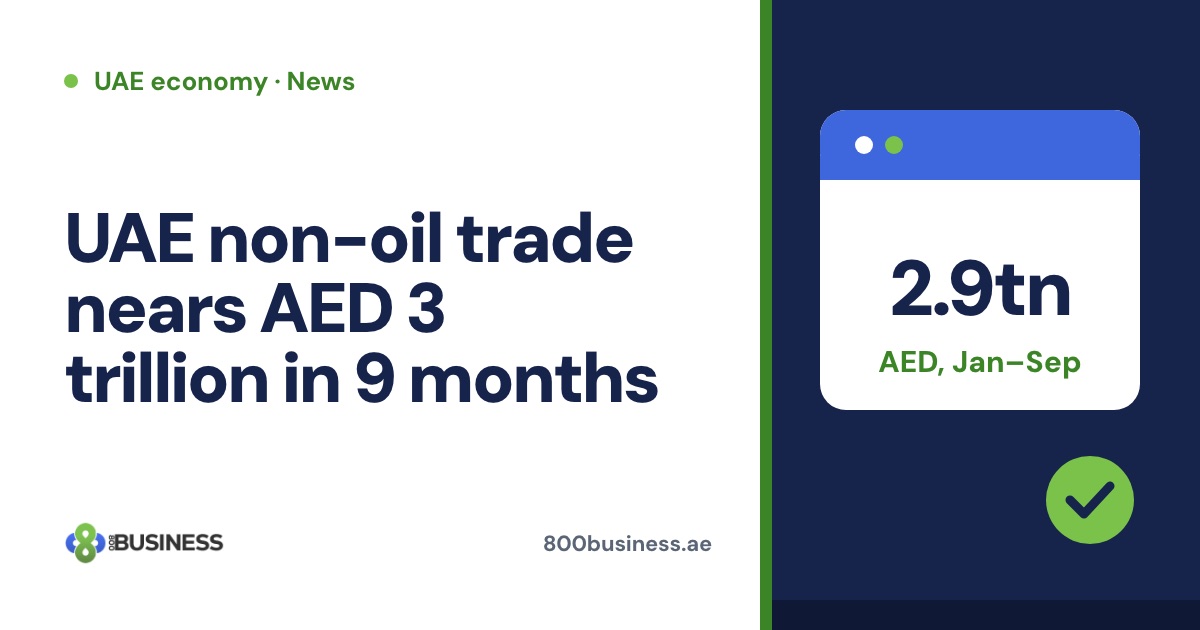
The UAE's non-oil foreign trade reached AED 2.945 trillion from January to September 2026, up 10.1% on the same months of 2025. Non-oil exports hit a record AED 705.8 billion, up 21.6%, and monthly exports passed AED 100 billion for the first time in September. The figures were announced on 8 November 2026.
What happened
HH Sheikh Mohammed bin Rashid Al Maktoum, Vice President, Prime Minister and Ruler of Dubai, shared the nine-month figures on 8 November. "For the first time, our non-oil foreign trade is nearing AED 3 trillion in just nine months," he said (WAM, 8 November 2026).
| January–September 2026 | Figure | Change on 2025 |
|---|---|---|
| Non-oil foreign trade | AED 2.945 trillion | +10.1% |
| Non-oil exports | AED 705.8 billion (record) | +21.6% |
| Q3 2026 non-oil trade | AED 1.025 trillion | +7.1% |
Exports to the UAE's top 10 trading partners grew 31.6%. Imports reached AED 1.661 trillion (+11.5%) and re-exports AED 578 billion.
Dr Thani bin Ahmed Al Zeyoudi, Minister of Foreign Trade, said quarterly non-oil exports have stayed above AED 200 billion for five quarters in a row. Trade with the 23 countries covered by the 19 Comprehensive Economic Partnership Agreements (CEPAs) in force on 20 October reached about AED 510.8 billion.
Who trades most with the UAE:
- Top export destinations: Switzerland, Hong Kong and India. Gold, jewellery and tobacco products led exports.
- Top re-export destinations: Saudi Arabia, Iraq and Oman.
- Top import sources: China, India and the United States.
Who it affects
- People planning a trading company. If you plan to buy and re-sell goods, these numbers show UAE trade grew again in 2026, with exports growing fastest.
- Businesses selling to Saudi Arabia, Iraq or Oman. These are the top re-export markets. A UAE company is one way to serve them.
- Exporters in countries with a CEPA. Lower trade barriers with those 23 countries can change where it makes sense to buy and sell.
- Not affected: service businesses with no goods, such as consultants or software. The news is about goods trade.
What to do now
- Pick the right activity on your licence. General trading and specific trading (for example, electronics or food) are different activities. Your licence must list what you actually sell.
- Choose a Free Zone that fits the goods. Some zones suit warehousing and logistics; others are desk-based. A Free Zone company can also sell to customers on the UAE mainland. A physical shop must be on the mainland. Start with our business setup in Dubai guide.
- Plan customs registration before your first shipment. In Dubai, a business registers with Dubai Customs through its business registration service, which lets it deal with Dubai Customs officially. Other emirates have their own customs authorities.
- Watch the VAT threshold. You must register for VAT once your taxable supplies and imports pass AED 375,000 in 12 months, or are expected to in the next 30 days (FTA). See VAT registration in the UAE.
Talk it through with us
On a free 30-minute Zoom call we look at what you plan to trade and where, and tell you which Free Zone, licence activity and visa fit, with every official cost in writing.
Book my free 30-minute call · WhatsApp us: +971 52 713 7661
Sources
- WAM (Emirates News Agency), Mohammed bin Rashid: UAE non-oil foreign trade nears AED 3 trillion in nine months as exports reach historic highs (8 November 2026), checked 11 November 2026
- Federal Tax Authority, VAT registration: AED 375,000 mandatory threshold, checked 11 November 2026
- Dubai Customs, Request Business Registration, checked 11 November 2026
This article is general information based on official sources. It is not legal or tax advice.
Next step: Business setup in Dubai