The short answer
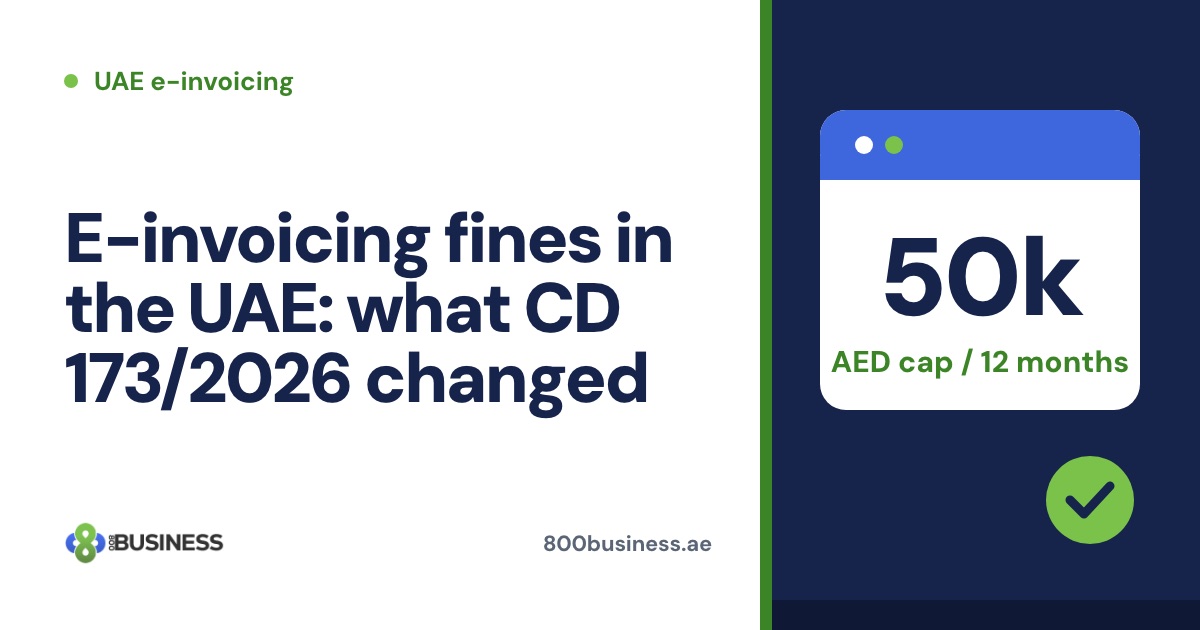
The UAE has new e-invoicing fines. Cabinet Decision No. 173 of 2026 replaces Cabinet Decision No. 106 of 2025. The main fine is for not joining the system on time, which includes not appointing an accredited service provider (ASP). It is AED 5,000, plus AED 5,000 for each month you stay out, capped at AED 50,000 in any 12 months. A daily fine fell from AED 1,000 to AED 250, and the two fines for not reporting a system failure are gone.
Last updated: 10 November 2026 · Facts checked on mof.gov.ae and tax.gov.ae on 10 November 2026 · By 800 Business
What changed: old fines vs new fines
The Ministry of Finance announced the new decision on 30 October 2026. It says the change came "following stakeholder feedback" and aims for penalties that are "clear, proportionate and practical" (MoF, checked 10 Nov 2026).
| Violation | Old fine (CD 106/2025) | New fine (CD 173/2026) |
|---|---|---|
| Not going live with e-invoicing, including not appointing an ASP | AED 5,000 for each month or part of a month of delay, no cap. Applied to the issuer only | AED 5,000 the first time, then AED 5,000 for each month or part of a month it continues. Maximum AED 50,000 in any 12 consecutive months. Applies to issuers and recipients |
| Not issuing and sending an e-invoice | AED 100 per invoice, up to AED 5,000 a month | Same: AED 100 per invoice, up to AED 5,000 a month |
| Not issuing and sending an e-credit note | AED 100 per credit note, up to AED 5,000 a month | Same: AED 100 per credit note, up to AED 5,000 a month |
| Not telling your ASP about changes to your FTA data | AED 1,000 a day, no cap | AED 250 a day, up to AED 5,000 a month |
| Issuer not telling the FTA about a system failure | AED 1,000 a day | Removed |
| Recipient not telling the FTA about a system failure | AED 1,000 a day | Removed |
Sources: CD 173/2026, annexed table, and CD 106/2025, annexed table. Both read on mof.gov.ae on 10 November 2026.
The system-failure fines went because the duty itself went. Ministerial Decision No. 197 of 2026 deleted the rule that made you report a system failure to the FTA, from 1 October 2026 (MoF, checked 10 Nov 2026).
The four fines that still apply, in plain words
1. Not joining the system on time. This is the big one. You must appoint an ASP and go live by your phase date. Missing it costs AED 5,000 the first time and AED 5,000 for every further month or part of a month. A business that only receives e-invoices can also be fined now, and so can a recipient that joins and then stops meeting its duties.
2. Not sending an e-invoice. Once you are live, each invoice to a business customer that doesn't go through the system costs AED 100. The monthly maximum is AED 5,000, which is 50 invoices.
3. Not sending an e-credit note. The same AED 100 each, up to AED 5,000 a month. You need an e-credit note when a sale is cancelled, the price drops, money is refunded, or there is an error (MD 243/2025, Article 6).
4. Not updating your ASP. If your details registered with the FTA change, you must tell your ASP in writing within 5 business days of the FTA confirming the change (MD 243/2025, Article 5). Each day late costs AED 250, up to AED 5,000 a month. Think of a new trade licence, a new address, or a VAT registration.
One protection is new: if you are both issuer and recipient for the same violation, you pay one fine, not two (Article 3(2)). One stays the same: businesses that join voluntarily before their date can't be fined under this decision (Article 2(2), as in the old decision).
How the AED 50,000 cap works: a worked example
Take a Dubai trading company with revenue of AED 6 million. Its deadline to appoint an ASP is 31 March 2027. Say it does nothing, and the FTA treats the violation as starting in month 1.
| Time out of the system | Fine under the new rules | Under the old rules, for comparison |
|---|---|---|
| First instance (month 1) | AED 5,000 | AED 5,000 |
| 3 more months | AED 20,000 | AED 20,000 |
| 6 more months | AED 35,000 | AED 35,000 |
| 9 more months | AED 50,000 (cap reached) | AED 50,000 |
| 11 more months (12 months in total) | AED 50,000 | AED 60,000 |
The figures follow the wording of the two decisions. The FTA hasn't yet published guidance on exactly how it counts the months.
Three things the cap does not do:
- It isn't a lifetime limit. The cap applies to "any period of 12 consecutive months". A business that stays out of the system for more than a year can face more fines.
- It doesn't cover the other fines. The per-invoice, per-credit-note and ASP-update fines have their own monthly limits on top. A business that goes live but keeps sending PDF-only invoices can face up to AED 5,000 a month for invoices alone.
- It doesn't replace tax penalties. The MoF guidelines say normal tax penalties under the VAT and Tax Procedures laws may still apply as well (UAE Electronic Invoicing Guidelines, section 11, checked 10 Nov 2026).
So the cap lowers the worst case, but waiting still costs real money. Compare it with the cost of signing up: every ASP must give each customer 100 free e-invoice exchange and reporting services a year (MD 168/2026, Article 9). Ask each ASP what you pay after that.
When do the fines start for you?
The decision takes effect on the day after it is published in the Official Gazette (Article 5). The fines only bite from your own mandatory date. Before that, using e-invoicing is voluntary and fine-free (Guidelines, section 8.2).
| Your business | Appoint an ASP by | Go live by |
|---|---|---|
| Revenue of AED 50 million or more | 30 October 2026 (passed) | 1 January 2027 |
| Revenue under AED 50 million | 31 March 2027 | 1 July 2027 |
| Government entities | 31 March 2027 | 1 October 2027 |
Sources: MD 244/2025, Article 5, as amended by MD 66/2026, and the FTA reminder of 25 October 2026. All checked 10 November 2026.
"Revenue" means gross income in your most recent accounting period, taken from your financial statements (MD 244/2025, Article 1). Most businesses fall in the second row: the Ministry says 82% of UAE businesses are micro businesses with turnover under AED 3 million (MoF e-invoicing page, checked 10 Nov 2026).
Revenue of AED 50 million or more and no ASP yet? You are already past the appointment date. Sign with one this week and get ready for 1 January 2027.
Starting a new company? The guidelines say a newly set-up business in scope must appoint an ASP and finish onboarding before it issues its first invoice (Guidelines, section 8.4). They don't yet spell out how this works for a company set up before its phase date, so check with your accountant before you send your first invoice.
Does this apply to Free Zone companies and businesses without VAT?
Yes to both. E-invoicing covers anyone doing business in the UAE, for business-to-business and business-to-government sales, whether or not they are VAT registered. A business with no FTA registration gets a 10-digit Tax Identification Number (TIN) through EmaraTax. Sales to consumers are outside the system for now (MD 243/2025, Article 3; MD 244/2025, Article 5(2); Guidelines, sections 6.1, 6.2 and 13.2).
How to stay clear of every fine
- Check your revenue in your latest financial statements, so you know your phase.
- Shortlist ASPs from the Ministry's official list. On 10 November 2026 it had 86 accredited providers (MoF ASP list).
- Sign before your deadline and onboard through EmaraTax. The guidelines say you start onboarding yourself, not the ASP.
- Test real invoices and credit notes before go-live, and agree with your ASP who fixes rejected invoices.
- Set a 5-business-day rule in your team: any change on EmaraTax goes to your ASP the same week.
The full timeline, scope and invoice types are in our guide to UAE e-invoicing in 2027.
Frequently asked questions
What is the fine for not appointing an e-invoicing service provider in the UAE? AED 5,000 the first time, then AED 5,000 for each month or part of a month you stay out, up to AED 50,000 in any 12 consecutive months (CD 173/2026, table item 1).
Is the AED 1,000 a day fine still in force? No. The two system-failure fines were removed, and the fine for not updating your ASP is now AED 250 a day, capped at AED 5,000 a month.
Can I be fined if I start e-invoicing early? No. Article 2(2) excludes people who use the system voluntarily. Fines start from your mandatory date.
Do I pay twice if I am both the supplier and the customer in the same deal? No. Article 3(2) says one fine per violation, whatever role you had.
My company is in a Free Zone and isn't VAT registered. Do the fines apply to me? Yes, once your phase starts, if you sell to other businesses or to government. You'll need a TIN and an ASP like everyone else.
Does the AED 50,000 cap cover all e-invoicing fines? No. It only covers the fine for not joining the system. The invoice, credit note and ASP-update fines have their own monthly limits.
This guide is general information based on official sources, reviewed by the 800 Business team. It is not tax advice.
Want to know where you stand before 31 March 2027?
In a free 30-minute Zoom call we check your revenue test, your current invoicing and your EmaraTax details, and tell you which date applies to you and what to do first. If you'd like, we keep your books and VAT in order so every e-invoice comes out of clean records, and you approve everything before it goes to the FTA.
Book my free 30-minute call · Message us on WhatsApp: +971 52 713 7661
Also useful: accounting services in Dubai · VAT registration in the UAE · corporate tax in the UAE
Sources
All sources read on 10 November 2026.
- Ministry of Finance, Cabinet Decision No. 173 of 2026 on the Violations and Administrative Penalties Resulting from Violation of the Legislation Regulating the Electronic Invoicing System: Articles 2–5 and annexed table
- Ministry of Finance, MoF announces updated administrative penalties related to the UAE eInvoicing system (30 October 2026)
- Ministry of Finance, Cabinet Decision No. 106 of 2025 (repealed): annexed table
- Ministry of Finance, Ministerial Decision No. 243 of 2025: Articles 3, 5 and 6
- Ministry of Finance, Ministerial Decision No. 244 of 2025 and Ministerial Decision No. 66 of 2026: revenue definition, phase dates and consumer sales (Articles 1 and 5)
- Ministry of Finance, Ministerial Decision No. 197 of 2026 (19 October 2026): system-failure notice removed
- Ministry of Finance, Ministerial Decision No. 168 of 2026: 100 free e-invoice services a year per customer (Article 9)
- Ministry of Finance, UAE Electronic Invoicing Guidelines: sections 6.1, 8.2, 8.4 and 11
- Ministry of Finance, list of eInvoicing Accredited Service Providers
- Federal Tax Authority, FTA calls on persons subject to e-invoicing to comply with the prescribed deadlines (25 October 2026)
Update trigger: the Official Gazette date of CD 173/2026; any FTA guide on how the AED 50,000 cap is counted; any new penalty decision.
Next step: Accounting services in Dubai